The first question I ask painter Deladier Almeida is “how” he sees the landscape. If his paintings are the answer, it’s as geometric forms and defined shapes that he stitches together into vibrant, undulating landscapes that are completely and distinctly his own.
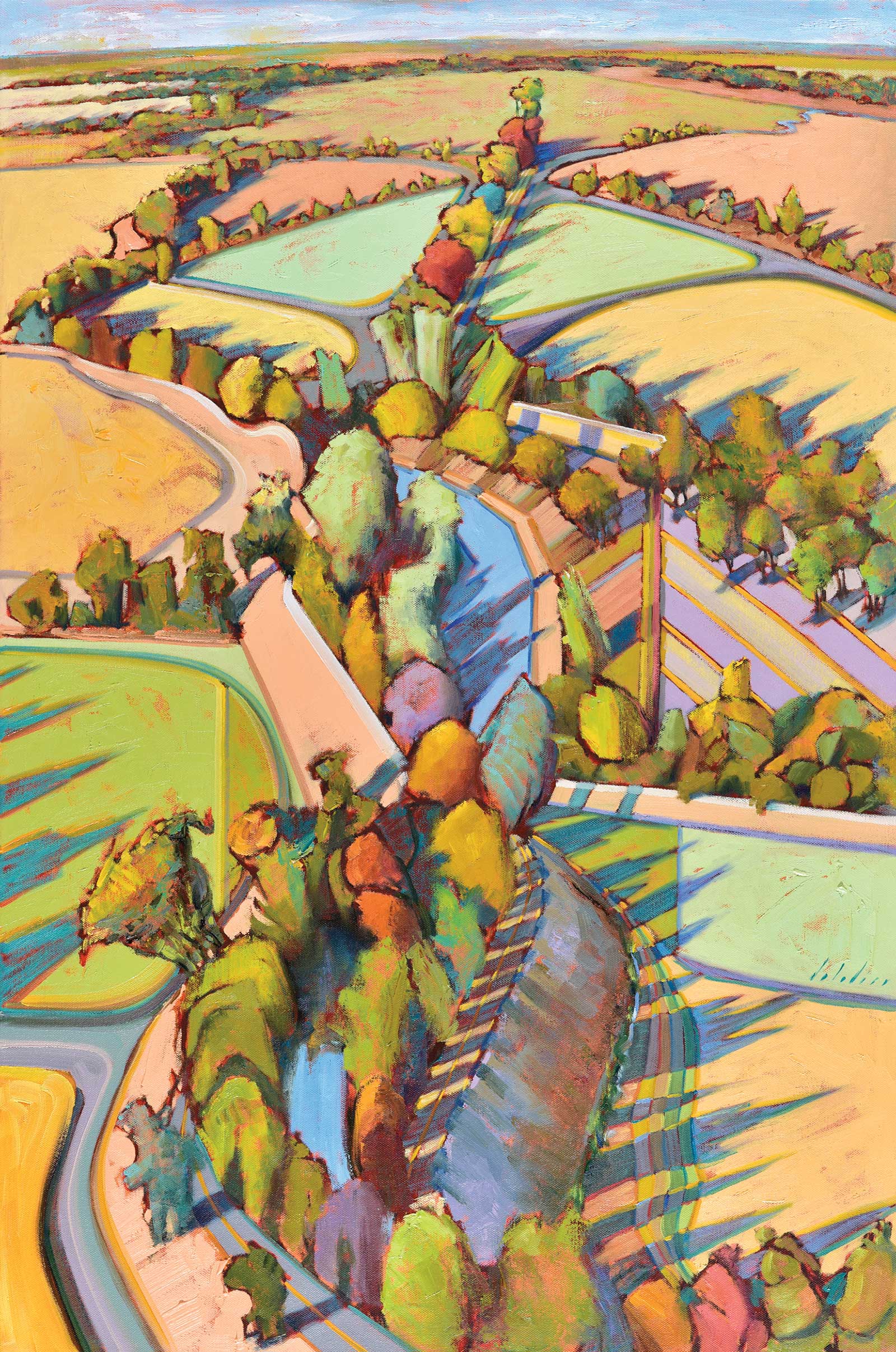
Trees Frolicking, oil on canvas, 36 x 24"
“Seeing and painting are the same thing,” says Almeida. “Your ability to paint is equal to your ability to see. How do I see reality and parse reality, and how do I break that down so that it’s relevant and harmonic in the unique universe of that painting? Seeing is editing visual reality. The ability to do that evolves with the work. It pokes at the core of one’s language as a painter. As your language develops, it changes how you see things. I’m looking at the edges of fields, shadows, water, and trying to think of those things as building blocks of a language. They’re verbs and pronouns. They begin to have a life of their own...[and] it becomes easier to choose what best serves the painting.”
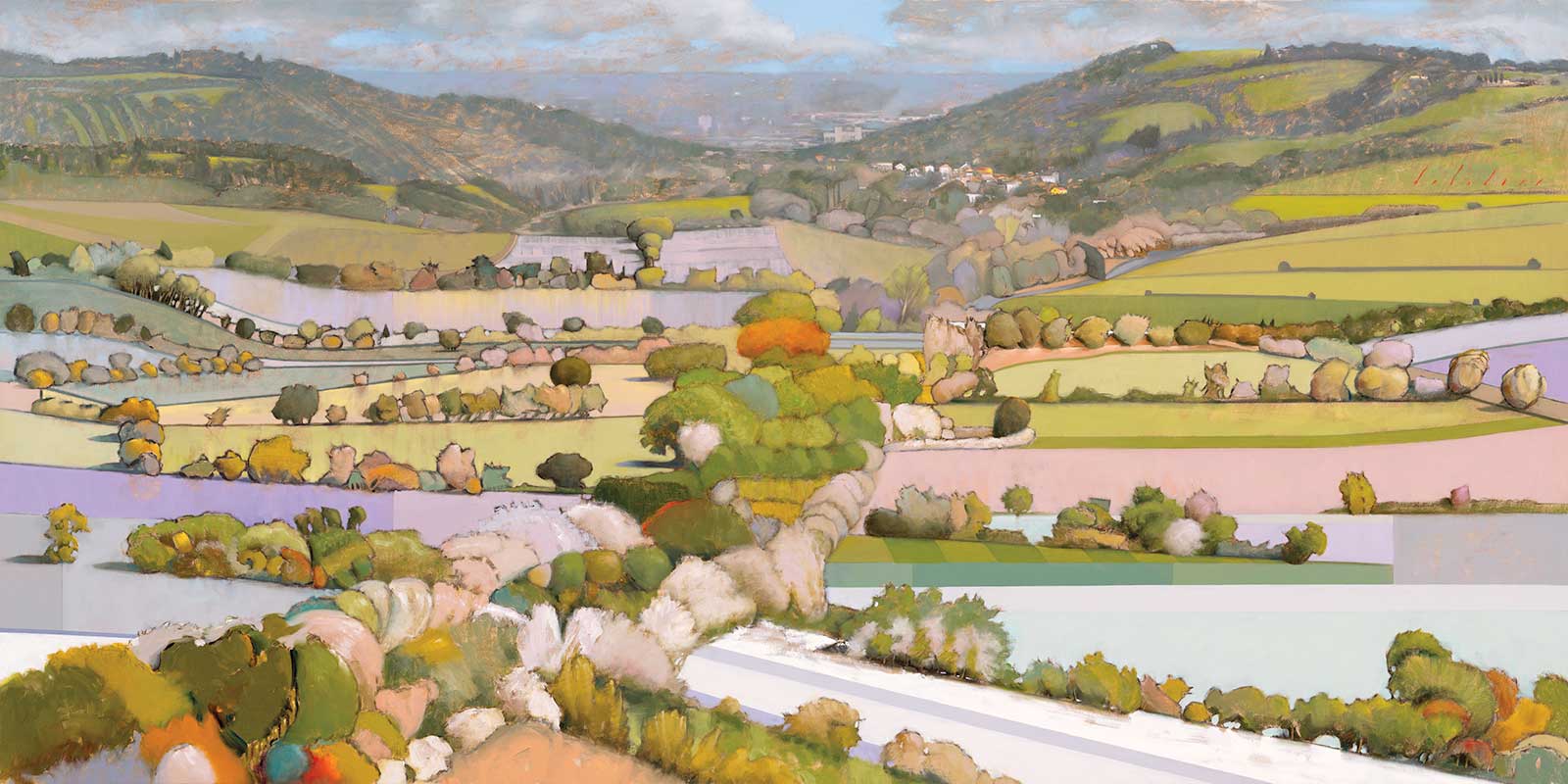
Tuscan Plumage, oil on canvas, 36 x 72"
Almeida’s latest body of work, the subject of a solo exhibition at Mark Sublette Medicine Man Gallery from March 14 through 28, is a mix of his aerial views of California’s Central Valley and another favorite subject of the artist’s, the Tuscan countryside.
For his California scenes, Almeida gathers his reference material from the vantage point of a helicopter in order to convey a broader view of the region. In Italy, he can survey the land from the heights of the province’s many hill towns.
“If I want to depict the place I live in with all its connections to the land, and the agriculture, you have to get up above,” says Almeida, who lives in Davis, California. “All of these changes in the environment can be seen…it’s a fantastically rich visual space that can always be tapped. I got enamored with the way of looking at the land this way from a vertical distance from high up. I just love it.”
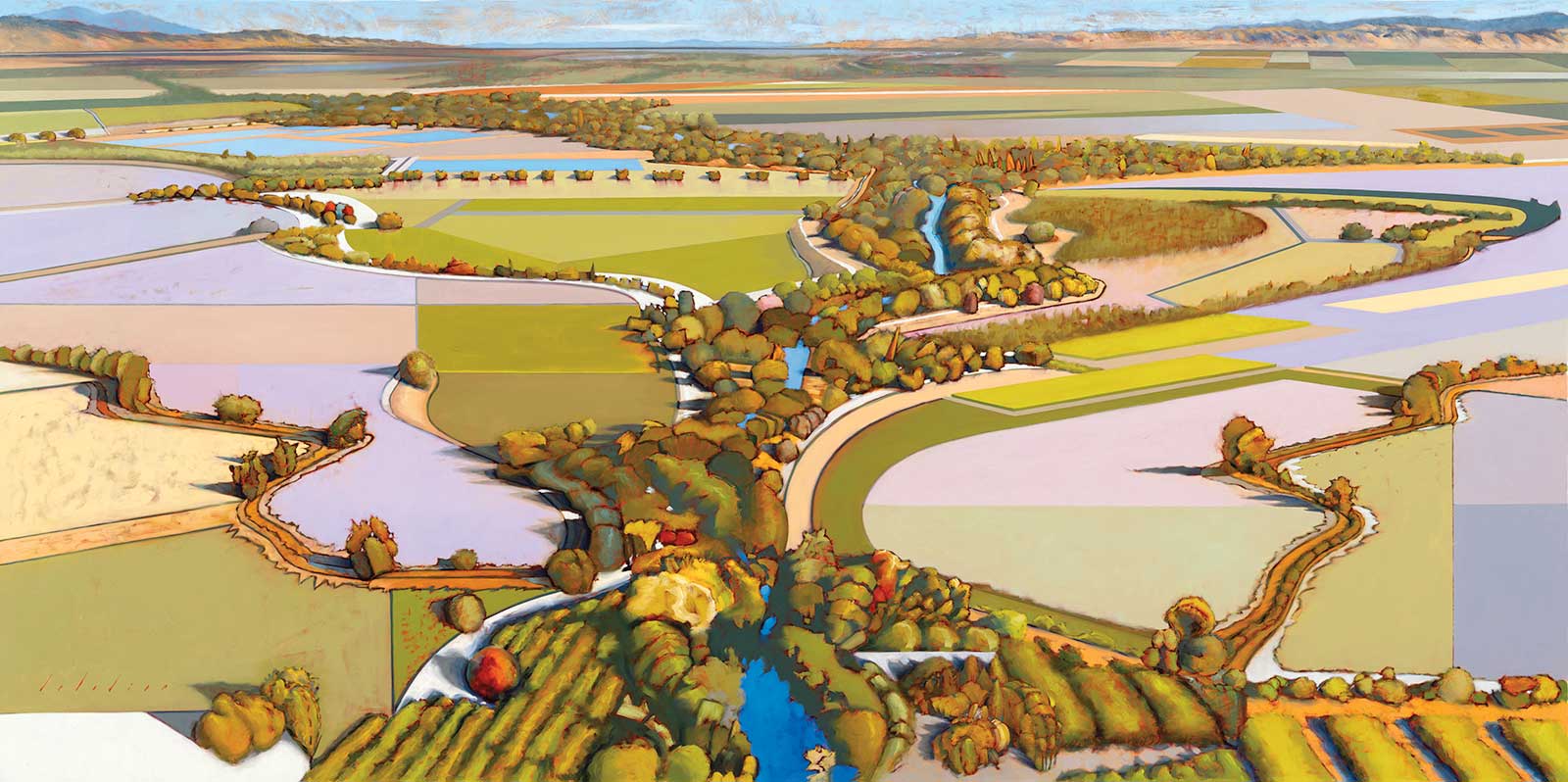
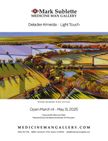
Light Touch, oil on canvas, 45 x 90"
Light Touch emerged after a helicopter ride in late 2024. The California farmland is shook out like a patchwork quilt below, woven through with meandering lines dotted with Almeida’s stylized trees, and pops of color that draw the eye toward the mountains on the distant horizon. Look closer and you’ll see another signature of Almeida’s work: his playful use of perspective. Some blocked out parcels appear to rise up vertically or take on a geometric dimensionality, abstract elements he pushes as far as he can and still keep the painting grounded in reality.
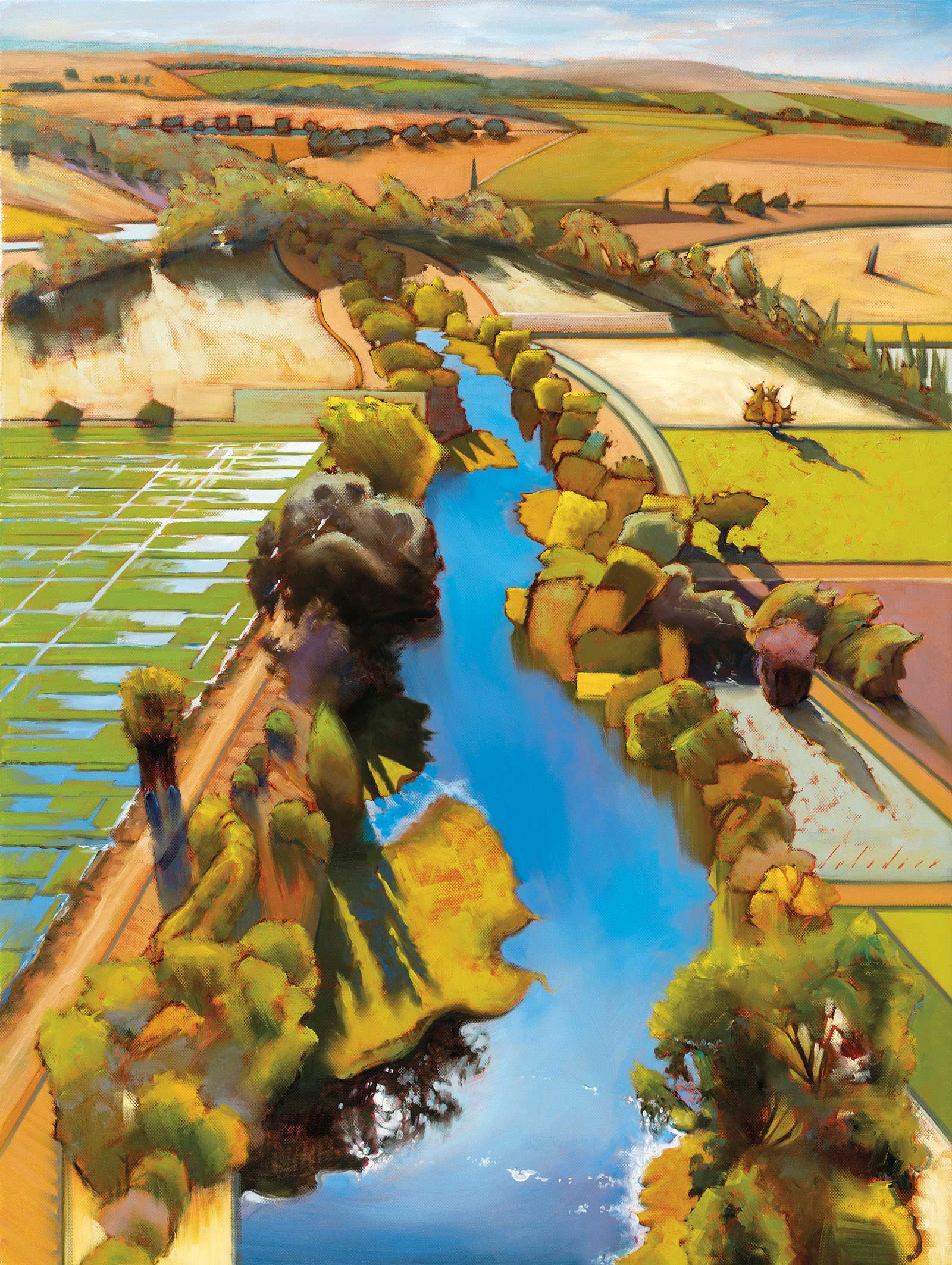
Specular, oil on canvas, 32 x 24"
“My whole pursuit is to bridge the language and the absolute reality, and at the same time create more territory between them,” he says. “When you can put more and more space between the two and still maintain the connection with reality, the language and the painting become more interesting, and still tells the story of the immediate stimulus. You can bring in all kind of abstract and pictorial devices to solve that problem, but you can still tell it’s Napa Valley in the afternoon. If you can sustain that, it’s a successful painting, and the language is evolving.”
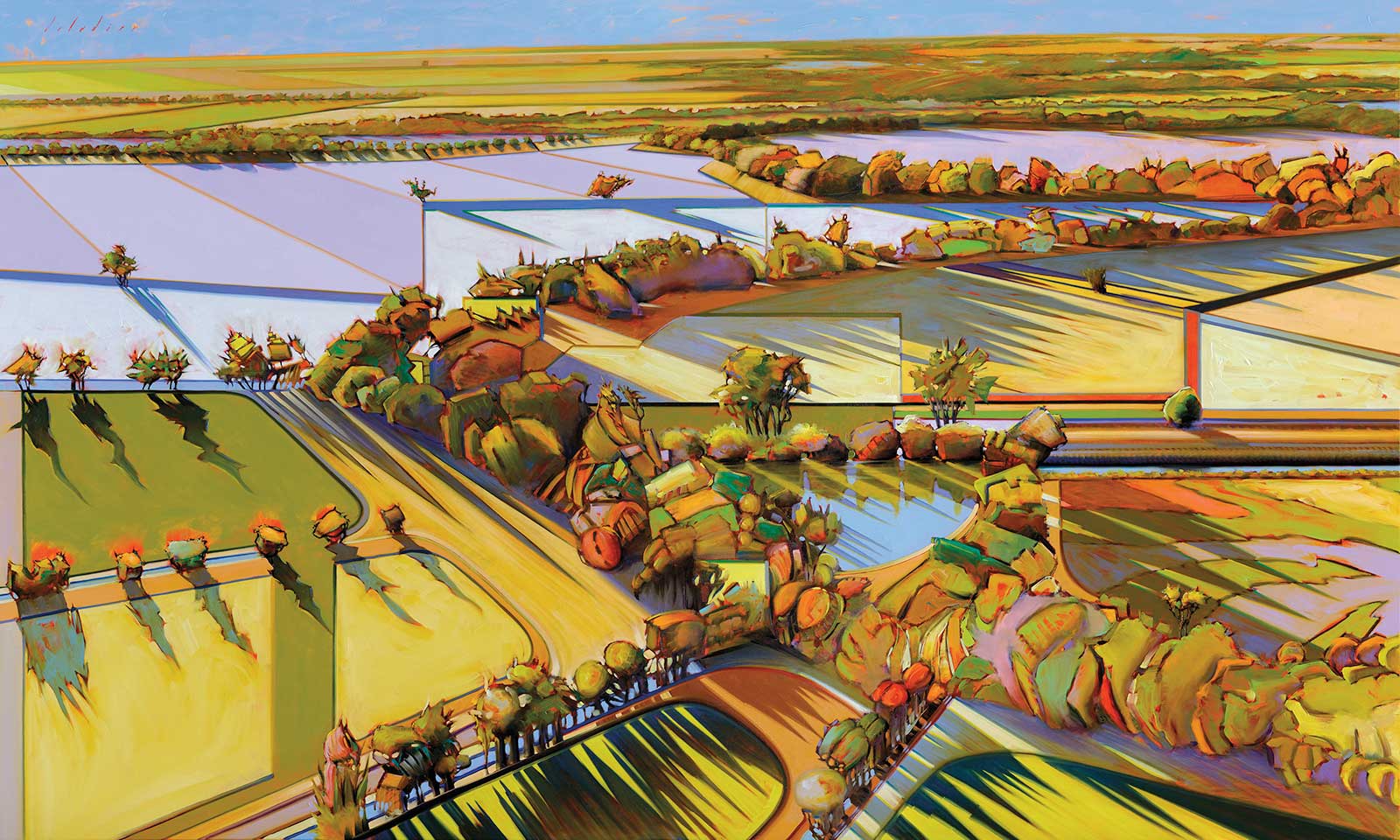
West Springing, oil on canvas, 48 x 80"
In Specular, Almeida pushed his geometric forms even further. The flooded fields back up to a sheer wall and the land on the other side of the river seems to bound into the background. “On the face of it it’s irrational,” he says. “When you understand perspective, it’s difficult to not use it or deny it. If you look above the field, it denies the perspective. It’s challenging the idea of the absolute depiction of reality. I’m pointing out that this is a two-dimensional painting, this is an abstraction. Wake up!”
Other elements, like the sense of volume created by the stretching shadows, provide the necessary counterbalance. “When you see something that makes sense you may not know why it makes sense but you know it,” he says. “You have to respect the innate ability of the viewer to perceive the quality of your efforts so that when they look at the painting it makes sense in an unconscious manner.”
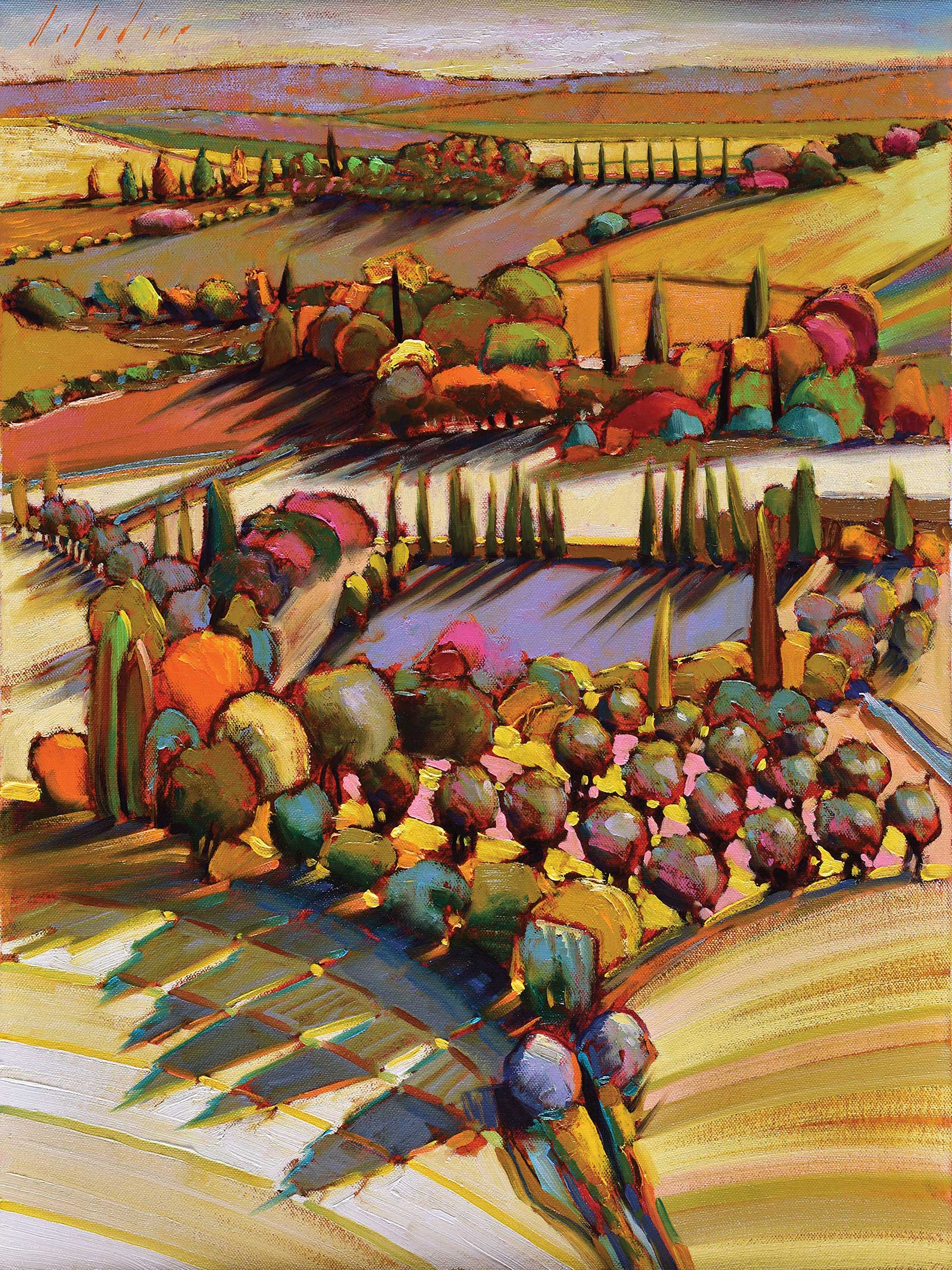
Flowing Patterns, oil on canvas, 24 x 18"
On the other end of the spectrum is Tuscan Plumage, a softer, lush depiction of a vista seen from the village of Certaldo last May. “When I came upon that scene, at first it was almost mundane,” he says. “Then I started looking…there was a spine that cut through the fields leading to the distant hills. All of a sudden, I was in love with it. There was a lightness to it and such a poetic appeal that was not driven by hard design or geometric opportunities. It was more tactile. More sensual. More lyrical. It’s something you can feel on the tips of your figures like wheat or flowers.”
Almeida’s solo exhibition opens at Medicine Man Gallery on March 14 with a reception from 5 to 7 p.m. —
Mark Sublette Medicine Man Gallery 6872 E. Sunrise Drive, Suite 130 • Tucson, AZ 85750 (520) 722-7798 • www.medicinemangallery.com
Powered by Froala Editor